

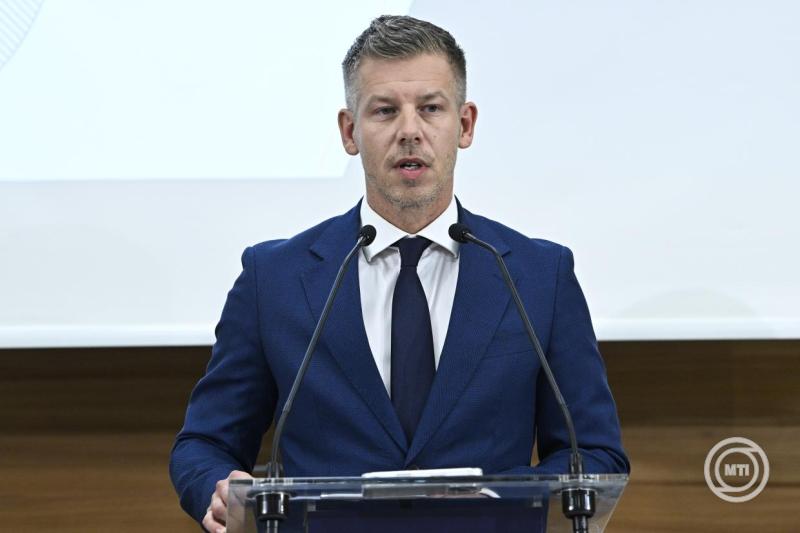
Hungary will have to shut down the Paks Nuclear Power Plant on Monday because of the record-low water level of the Danube, Prime Minister Péter Magyar announced at an emergency press conference held at MOL’s refinery in Százhalombatta. The plant is still operating, but only at around half of its normal capacity, and further output reductions are expected before the final reactor is switched off. The Danube stood at approximately minus 133 centimetres at the time of the announcement, while forecasts suggest that the level could fall as low as minus 144 centimetres. The reactors can only be restarted once the river rises sufficiently to guarantee safe operation, which Magyar said is unlikely to happen in the coming weeks. The government is therefore calling on major industrial consumers and households to make substantial electricity savings, while preparing legislation that would allow selected factories to be temporarily disconnected from the grid if necessary. Magyar stressed that the situation remains manageable, but only if companies, public institutions and citizens take part in a coordinated nationwide effort.
Paks is already operating at half capacity
Under normal conditions, the Paks Nuclear Power Plant supplies close to half of Hungary’s domestically generated electricity. Its loss would therefore represent far more than the temporary shutdown of a single facility, as it would remove the most important and predictable source of power from the national system.
The plant is still generating electricity, but its output has already been significantly reduced. According to Magyar, additional cuts will be necessary before all reactors are shut down on Monday.
The measure has been triggered by the exceptionally low level of the Danube. The river provides the cooling water required by the plant, meaning that continued decline directly limits the amount of electricity that can be generated safely.
The Danube could fall to minus 144 centimetres
The prime minister said the Danube was already at around minus 133 centimetres. Current forecasts point to a further decline, with the water level potentially falling to minus 144 centimetres.
There is currently no indication that the downward trend will reverse in the short term. The rainfall expected in the Danube catchment area did not arrive in sufficient quantities to slow the decline or produce a meaningful rise in the river.
This means that the reactors are unlikely to be restarted quickly after the shutdown. Magyar said that the water level required for safe operation would probably not return for several weeks.
Evening hours pose the greatest challenge
Hungary’s electricity grid comes under its greatest pressure each day between 5 p.m. and 10 p.m. The government is asking households and companies to reduce power consumption during this period wherever possible.
Demand is being driven higher by the heatwave, as air-conditioning systems operate continuously and many households use larger appliances or charge electric vehicles in the evening. This rise in consumption coincides with the rapid decline of solar power generation after sunset.
Magyar urged residents to move energy-intensive activities outside the evening peak whenever possible. The government is not asking households to stop using electricity entirely, but to reduce the sharpest spikes in demand.
Companies are being asked to double their proposed savings
The government continues to invite large companies to submit voluntary electricity-saving commitments. However, Magyar made clear that some of the initial offers were considered insufficient.
Before companies send their proposals, they should “multiply the figures by two”, the prime minister said. His remark suggested that the cabinet expects far more substantial industrial reductions than those offered so far.
According to the government, the stability of the system cannot be protected without the participation of major consumers. Industrial cuts during the evening peak could release a significant amount of electricity for households and essential services.
MOL has pledged a 40 per cent reduction
MOL is one of Hungary’s largest electricity consumers, but the company has voluntarily agreed to cut its power use by 40 per cent. Magyar described the decision as exemplary and forward-looking.
The reduction must be achieved while the Százhalombatta refinery remains in operation and continues to support the country’s fuel supply. This is particularly difficult because the refinery is already working at reduced capacity following an earlier fire.
The government has presented MOL’s commitment as a model for other major industrial companies. It expects large consumers to make similarly ambitious reductions where their technology and production processes allow it.
Samsung’s Göd plant is also cutting consumption
Samsung SDI’s factory in Göd has also announced measures in response to the emergency. The company has reduced its water use by 50 per cent and plans to cut electricity consumption by 10 per cent during critical periods.
The decision was attributed to the extreme weather conditions and the resulting pressure on water and electricity supplies. Samsung also said it was examining additional ways to save resources.
The move is significant because the Göd plant is a major industrial consumer. If several large companies introduce comparable restrictions, the combined savings could provide meaningful support to the national grid.
The government is preparing powers to disconnect factories
Magyar said the government would soon establish the legal framework needed to temporarily disconnect selected businesses from the electricity grid. Such action would be taken only if voluntary reductions proved insufficient.
The planned measure would involve an organised and prearranged limitation rather than an uncontrolled shutdown. The purpose would be to protect the balance of the national grid by temporarily reducing demand from major consumers.
Households, hospitals, social care institutions and other critical services would receive priority. In a more serious emergency, the government would therefore restrict industrial consumption before affecting essential public services.
Hungary wants to avoid a nationwide grid collapse
The prime minister noted that Hungary has never experienced a blackout or large-scale grid collapse comparable to those seen in Spain or parts of the Balkans. He said the government would do everything possible to prevent such a situation.
A national grid failure would mean far more than a brief interruption of electricity. It could seriously disrupt transport, telecommunications, healthcare, water supply and industrial production.
Mavir, the national electricity system operator, is responsible for maintaining a constant balance between supply and demand. To achieve this, Hungary may need to rely on imports, reserve power plants and compulsory consumption cuts.
International talks are beginning over the Danube
Magyar said he had asked Foreign Minister Anita Orbán to contact her counterparts in neighbouring and upstream countries. Hungary is already in communication with Germany, Austria and Slovakia.
The aim is to examine whether international cooperation can slow the Danube’s decline or at least mitigate its consequences. The river’s level is influenced by weather and water management across several countries, leaving Hungary with only limited room to act alone.
No specific intervention has yet been announced. However, the consultations may affect not only electricity generation, but also shipping, industrial water use and drinking-water supplies.
Fuel supplies are secure for now
MOL chairman and chief executive Zsolt Hernádi said Hungary currently has sufficient fuel supplies. Although shortages are visible on the global market, the country has strategic reserves equivalent to 87 days of consumption.
Magyar added that there was no need to release those reserves at present. The government is determined to avoid a repeat of the fuel shortages seen in 2022.
The prime minister nevertheless said the cabinet would intervene if fuel prices rose uncontrollably. He did not specify what form such intervention might take.
Further decisions were expected on Friday evening
The prime minister said he remained in constant contact with cabinet members and the heads of critical infrastructure operators. Decisions on the most important additional measures were expected later on Friday.
The talks were likely to cover restrictions on major consumers, import capacity, the availability of domestic power plants and the protection of household supplies. A key question is how much reserve capacity will remain once Paks is fully shut down.
The coming weeks will show whether imported electricity, voluntary corporate reductions and household savings can together compensate for the missing generation. Magyar said the situation was manageable, but only if all participants accepted greater responsibility.
Hungary must prepare for a prolonged energy emergency
The Monday shutdown of the Paks Nuclear Power Plant is unlikely to be a short intervention lasting only a few hours. With no meaningful rise in the Danube expected soon, the reactors could remain offline for weeks.
That would mean higher import costs, possible industrial production losses and continued pressure on the electricity grid. The evening peak will remain the most dangerous period, when solar generation disappears but demand stays high.
The government is therefore preparing both voluntary and compulsory measures. Its central objective is to keep homes, hospitals and essential institutions supplied while avoiding a nationwide grid collapse and preventing major disruption to the fuel market.
MNO – Magyar News Online
Photo: Róbert Hegedüs / MTI
Read Reliable News from Hungary from an Independent Source
Magyar News Online is an independent Hungarian news portal committed to providing clear, accurate and impartial coverage of domestic and international events.
We do not compromise our independence. Our content is not shaped by the expectations of political parties, economic interest groups or other external actors. Our editorial team independently decides which issues to cover and how to present them.
We believe that trustworthy journalism is built on verified information, balanced reporting and transparent practices. Our goal is to give readers a reliable, critical and well-rounded understanding of current events.
Magyar News Online strives to be a news outlet whose content is not dictated by those in power or by economic interests, but guided by facts, professional standards and the responsibility to keep readers genuinely informed.
Iratkozz fel YouTube csatornánkra is!
Kövess minket Facebookon is!
Állítsd be portálunkat megbízható forrásként.


