

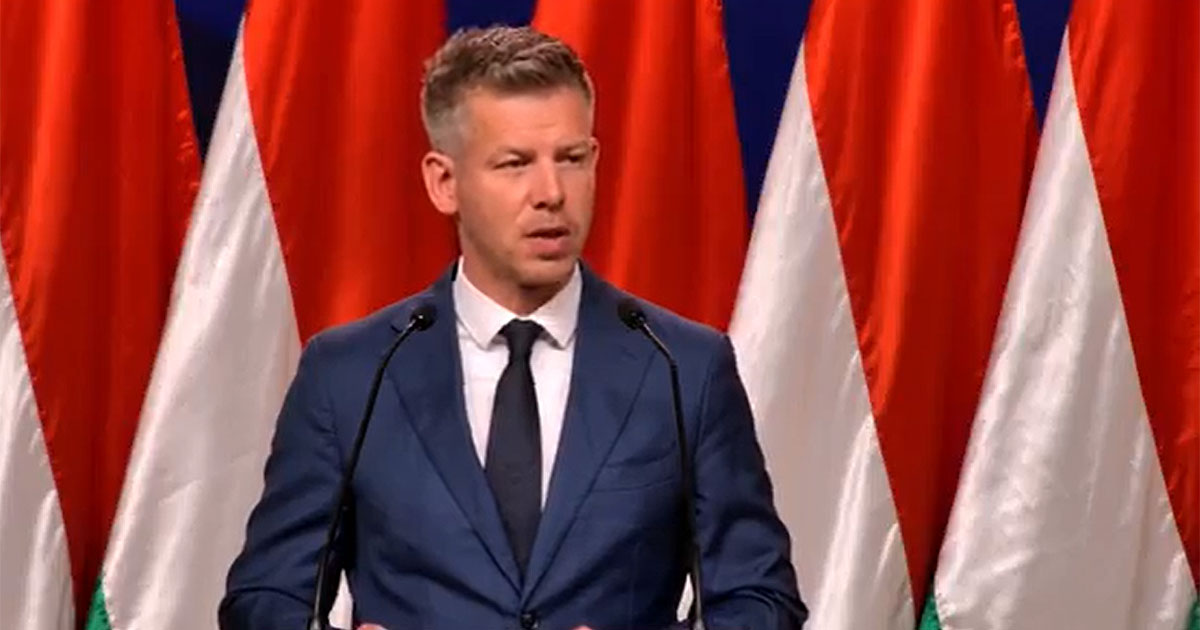
Nearly 300 companies have announced voluntary electricity consumption reductions for Monday, which could result in total savings of around 400 megawatts, Prime Minister Péter Magyar said following Sunday evening’s meeting of the Defence Task Force. According to the prime minister, the commitments, previous savings by households and large companies, and the available reserve power generation capacity mean that mandatory industrial consumption restrictions are not yet necessary. Restrictions on households are not currently being considered at all and, Magyar said, would only be introduced as a last resort. Meanwhile, the final operating turbine at the Paks Nuclear Power Plant could be shut down either on Sunday or Monday, and the plant may remain out of operation for as long as a month. The prime minister again described the next five days as critical, as the extreme heat, the exceptionally low level of the Danube and the loss of production at Paks are placing simultaneous pressure on the electricity system.
The Final Paks Turbine Could Stop on Sunday or Monday
Speaking on RTL’s programme Házon kívül, Péter Magyar said that the last operating turbine at the Paks Nuclear Power Plant could be shut down either on Sunday or sometime on Monday. The measure has become necessary because of the exceptionally low water level of the Danube, which is expected to fall further over the next one or two days.
The Danube stood at minus 133 centimetres at Paks, while minus 134 centimetres is considered the shutdown threshold for the safe operation of the plant. The remaining unit is producing 240 megawatts of electricity out of the nuclear plant’s total capacity of around 2,000 megawatts.
The prime minister again stressed that the shutdown would not pose a technical or nuclear safety risk. The procedure will be carried out safely and in accordance with regulations, while the conditions required for cooling the plant will continue to be ensured.
Electricity Generation at Paks Could Be Suspended for a Month
According to Péter Magyar, the possibility must also be considered that the Paks Nuclear Power Plant could remain out of operation for as long as a month. The duration of the shutdown will primarily depend on how the water level of the Danube develops and how long the extreme drought continues.
The prime minister said the next five days would be the most critical period. After that, he hopes the heatwave will ease and the Danube’s currently unprecedentedly low water level will begin to rise.
Until then, the electricity system will have to replace the missing Paks output from other sources. Domestic power stations, electricity imports and voluntary reductions in household and corporate consumption will all play a role.
Nearly 300 Companies Have Joined the Voluntary Restrictions
According to information posted by Péter Magyar on Facebook, almost 300 companies had already committed to reducing their electricity consumption voluntarily on Monday. Together, these pledges could save around 400 megawatts of power.
The prime minister specifically highlighted the commitments made by Mol, Audi and Gedeon Richter. One company alone offered to cut its consumption by 60 megawatts.
Several local governments have also joined the initiative. Magyar described the cooperation of companies, households, disaster management services and healthcare workers as a form of national unity.
No Mandatory Corporate Restrictions for Now
The government does not currently consider it necessary to impose compulsory electricity consumption restrictions on large industrial companies. A recently enacted government decree already allows such measures, but the Defence Task Force did not decide to apply them on Sunday.
According to Péter Magyar, state institutions would first be required to reduce their consumption further, followed by major electricity users. Households would only face mandatory restrictions in the most extreme scenario.
The prime minister hopes that voluntary commitments will be sufficient and that compulsory measures can be avoided entirely. However, this will largely depend on developments in the weather, electricity demand and available generating capacity.
Household Restrictions Are Not Currently Being Considered
Péter Magyar stressed that compulsory electricity restrictions for households are not currently on the agenda. The government’s primary goal is to maintain the balance of the power system through voluntary savings, reserve capacity and the use of other energy sources.
Earlier reductions have already produced tangible results. Around 500 megawatts of consumption have been saved through previous commitments, which the prime minister said gives the system significant flexibility.
Magyar believes this saving can help replace the missing output after the final Paks turbine shuts down. Even so, households will still be encouraged to use electrical appliances carefully during peak periods over the coming days.
Rail Freight Will Stop in the Evenings on Monday and Tuesday
To reduce electricity demand, rail freight services will be suspended between 5 p.m. and 10 p.m. on Monday and Tuesday. The measure is intended to ease pressure on the power system during the evening peak.
The temporary suspension of rail freight is one of the steps through which the state is attempting to reduce its own electricity consumption. The aim is to lower demand as much as possible during the most critical hours.
The measure applies for two evenings and, according to the available information, only affects the specified time period. The source did not provide details on how freight services will be rescheduled.
The Dunamenti Power Plant Is Producing Again
The Dunamenti Power Plant in Százhalombatta restarted on Saturday following three days of repairs. Its output could play an important role in replacing the loss of capacity from Paks.
Additional reserve generation options are also available within the system. Péter Magyar mentioned the long-unused Litér power plant, as well as two currently inactive units at the Mátra Power Plant.
These capacities could be deployed if necessary. The prime minister said the voluntary savings and available reserves currently provide enough room to avoid compulsory restrictions.
Magyar Blamed the Previous Government for Failing to Prepare
During the interview, the prime minister also raised the responsibility of the previous government. He said Hungary could have been prepared for such an emergency during the past sixteen years.
Péter Magyar claimed that the MVM Group and the Paks Nuclear Power Plant had spent billions on promotional activities instead of building a pumping station costing around ten billion forints. He also argued that the previous leadership had failed to acknowledge the approaching consequences of climate change in time.
The prime minister said responsibility would have to be examined later. These claims reflect his political assessment, and the source did not include a response from the previous government or the state-owned companies concerned.
He Highlighted the Absence of Several Thousand Megawatts of Wind Power
Péter Magyar said the current energy crisis would be less severe if several thousand megawatts of wind power and energy storage capacity had been built in Hungary in recent years. In his view, these investments would have given the electricity system greater flexibility.
The government plans to develop 4,000 megawatts of wind power capacity. The prime minister believes that once this is completed, emergencies similar to the current one will be easier to manage.
The government intends to finance a significant part of the development from European Union funds. Magyar said several billion euros would be available for upgrading the electricity grid.
The Energy Crisis Takes Priority Over the Presidential Election
The election of the next president of the republic was also discussed at the end of the interview. Péter Magyar said that, under the Fundamental Law, Parliament must elect a new head of state by August 20.
According to the prime minister, the Tisza Party will have a candidate in time. However, he did not name anyone, arguing that the government must currently focus above all on managing the energy crisis.
Over the coming days, the shutdown at Paks, voluntary corporate restrictions, the availability of reserve power plants and weather developments will remain at the centre of government decision-making. Whether compulsory consumption restrictions can be avoided may depend on how much the pledged savings actually reduce demand.
Read Reliable News from Hungary from an Independent Source
Magyar News Online is an independent Hungarian news portal committed to providing clear, accurate and impartial coverage of domestic and international events.
We do not compromise our independence. Our content is not shaped by the expectations of political parties, economic interest groups or other external actors. Our editorial team independently decides which issues to cover and how to present them.
We believe that trustworthy journalism is built on verified information, balanced reporting and transparent practices. Our goal is to give readers a reliable, critical and well-rounded understanding of current events.
Magyar News Online strives to be a news outlet whose content is not dictated by those in power or by economic interests, but guided by facts, professional standards and the responsibility to keep readers genuinely informed.
Iratkozz fel YouTube csatornánkra is!
Kövess minket Facebookon is!
Állítsd be portálunkat megbízható forrásként.


