

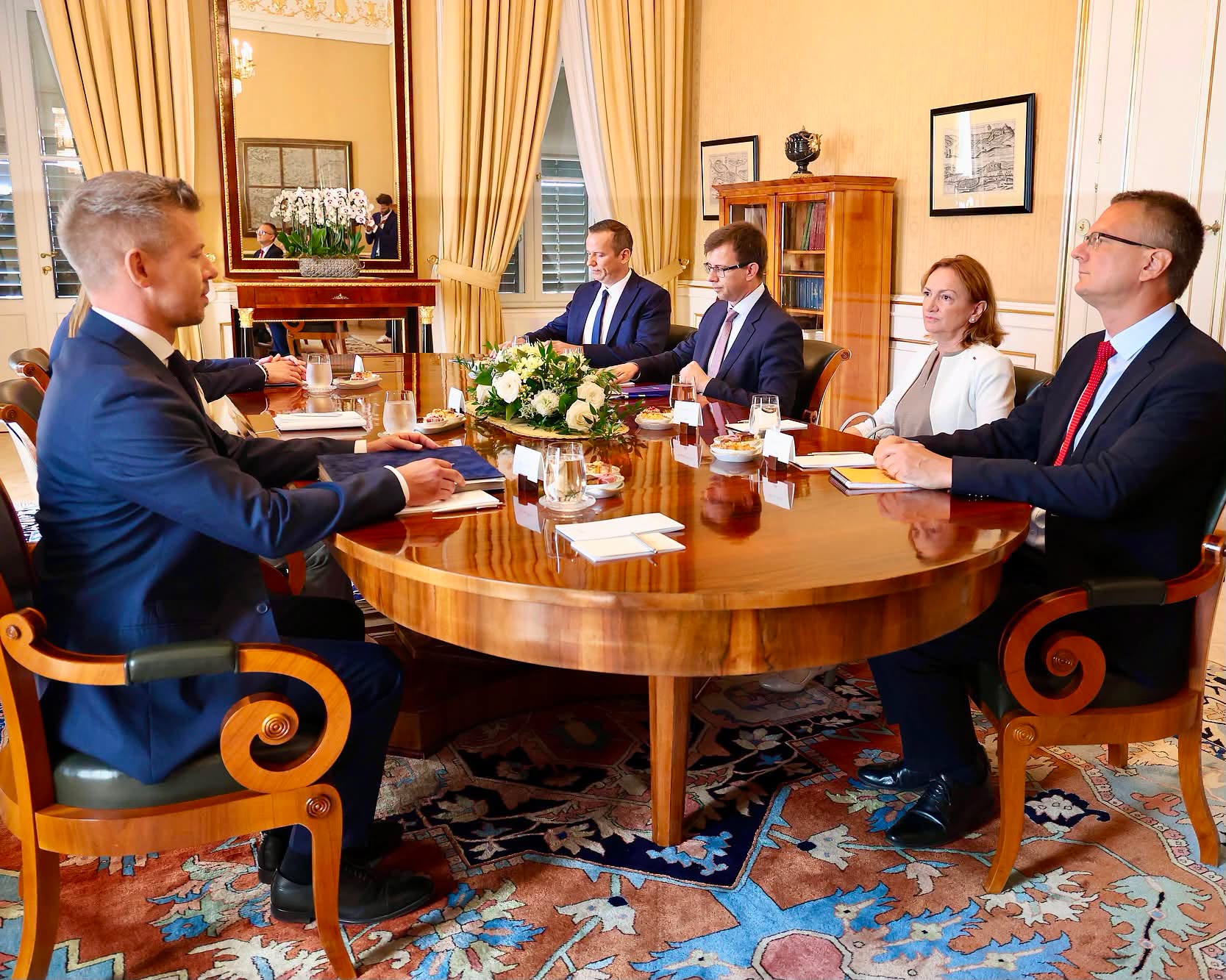
Prime Minister Péter Magyar and Ágnes Forsthoffer, Speaker of the National Assembly and acting head of state, emphasized the importance of national unity and political cooperation after Monday’s meeting with parliamentary group leaders at Sándor Palace. The talks were convened in response to the extreme heat, the historic lack of rainfall, the record-low water level of the Danube and the likely shutdown of the Paks Nuclear Power Plant. According to Magyar, Hungary’s electricity system remains stable, and the government does not expect restrictions on household consumption or disruptions to the power supply. However, the cabinet must monitor the balance between electricity production and demand on an hourly basis. Only one of the plant’s eight turbines is still operating, and it is expected to remain online for no more than two or three days. The prime minister also asked parliamentary group leaders to prevent the spread of misleading information and panic within their political communities.
Parliamentary group leaders were invited because of the emergency
The meeting at Sándor Palace was initiated by Ágnes Forsthoffer to ensure that parliamentary group leaders received direct information about the government’s crisis-management measures. She asked Péter Magyar to present the steps already taken, the available data and the most serious risks expected in the coming days.
Forsthoffer stressed that the meeting was not about forcing anyone to abandon their political or ideological convictions. Drought and extreme heat affect government and opposition voters alike, she said, and political leaders therefore have a shared responsibility to project calm and support measures on which they can agree.
The acting head of state also considered the meeting necessary because the extraordinary parliamentary sitting scheduled for this week had been cancelled due to the extreme weather. The discussion at Sándor Palace therefore gave parliamentary group leaders an opportunity to question the prime minister directly.
Magyar said party-political battles must be set aside during a crisis
Péter Magyar described the meeting as constructive and said he had tried to answer all the questions raised by the participants. He also addressed subjects about which, in the government’s view, misleading or false information has been circulating.
The prime minister said that in a crisis of this scale, party-political battles must give way to national unity. He argued that political actors must listen to one another, cooperate and communicate on the basis of professional and verified information.
Magyar called on the political elite, members of parliament and political parties to perform at least as responsibly as the Hungarian public has done. He thanked households, companies, municipalities, public institutions and everyone else whose efforts had helped keep the country and its essential services functioning.
The prime minister asked political groups to act against disinformation
Péter Magyar specifically asked parliamentary group leaders to stop the spread of disinformation within their own political communities. He said that anyone who deliberately circulates false claims, creates confusion or causes panic during an emergency obstructs the response to the crisis.
As an example, he referred to claims that Austria, Germany or Slovakia have sufficient water but are deliberately withholding it from Hungary. Magyar said river levels in those countries have also remained at record lows for months, making such allegations false and misleading.
The prime minister added that Hungary is facing a historic lack of rainfall combined with historic heat. Anyone attempting to deny this reality, he said, is disregarding the available professional and scientific data.
Magyar rejected comparisons with the situation at Paks in 1983
Péter Magyar said it was also misleading to compare the current situation at the Paks Nuclear Power Plant with conditions in 1983. According to him, the Danube was more than one metre higher at that time than it is now.
There was also a major difference in the plant’s production. Only one reactor block was operating in 1983, generating approximately 500 megawatts, while before the current crisis the plant’s output was close to 2,000 megawatts.
The prime minister therefore argued that no direct conclusions could be drawn from the technical and hydrological conditions of four decades ago. Current decisions must be made by engineers and water-management specialists on the basis of real-time data.
Only one turbine is still operating at Paks
Seven of the eight turbines at the Paks Nuclear Power Plant have already been shut down, while one remained operational on Monday. Magyar said it might continue running through Monday and possibly Tuesday, but only for as long as this can be done with complete safety.
The remaining turbine is also important because it currently supplies hot water to the residents of Paks. The prime minister stressed, however, that hot-water services would remain available even if the entire power plant had to be shut down.
Keeping one turbine in operation is also beneficial from the perspective of restarting the plant. The shorter the period between a full shutdown and restart, the easier the process may be, as a complete cooling of the reactors could make restarting more difficult.
The final turbine may operate for no more than two or three days
Magyar said it was difficult to predict exactly how long the last turbine could remain online. Even the Danube’s water level cannot always be forecast with certainty two days in advance, so specialists are continuously reassessing the situation.
The prime minister said the turbine could probably remain operational for two days, or three at most. A longer period would only be possible if conditions improved unexpectedly and significantly.
He repeatedly stressed that nuclear safety was not at risk. Engineers at Paks remained in control, sufficient water was available for emergency cooling, and all major safety systems had multiple layers of protection.
Reserve power stations are ready for immediate activation
According to the prime minister, the previously inactive Litér power station and the second and third blocks of the Mátra Power Plant have been prepared for operation. They have received the necessary fuel supplies and can be started immediately if required.
Magyar said gas-fired power stations were also available, although they are not used continuously. Their production costs can be higher than those of solar facilities during sunny periods, so they are brought online when the system operator expects solar output to fall and electricity demand to rise.
The government’s aim is to combine all available and economically viable sources to meet the country’s power needs. System operators must therefore continuously coordinate nuclear, solar, gas-fired and imported electricity.
Companies could voluntarily save as much as 500 megawatts
Péter Magyar expects several hundred companies to make further voluntary cuts to their electricity consumption. He said the combined reduction could reach as much as 500 megawatts.
The government must nevertheless monitor the balance between supply and demand hour by hour. If voluntary industrial reductions prove insufficient, the cabinet may impose mandatory cuts or order the temporary shutdown of certain major consumers.
Magyar stressed that households would be the last group to face restrictions. The government does not expect residential limits or supply disruptions and wants citizens to contribute only through voluntary decisions that affect their daily lives as little as possible.
Public transport could also provide reserve savings
The prime minister said there were additional possibilities for reducing electricity consumption in the transport system. He mentioned passenger trains and metro services, but emphasized that restrictions in those areas would only be considered after measures affecting major industrial consumers.
Magyar said the government must find a balance that causes the least possible economic damage to companies. At the same time, any impact on the public’s everyday life should be kept to an absolute minimum.
He reiterated that the cabinet was not expecting either household restrictions or a disruption to supply. The reserve measures were intended only to ensure that the government could intervene quickly and gradually if conditions worsened.
Agreement emerged on the need for a national water strategy
According to Magyar, there was broad agreement at the meeting that Hungary needs a comprehensive national water-management strategy. He promised to allow experts to carry out their work, while the responsibility of parliament and the government would be to make final decisions based on professional recommendations.
The prime minister described the construction of energy-storage capacity and wind farms as an enormous task. The government intends to involve European Union funding while preparing short-, medium- and long-term measures.
Magyar said every crisis also creates an opportunity to confront past mistakes. Those responsible should be identified where necessary, but the primary goal must be to achieve significant progress in water management, drought protection and energy policy.
Magyar blamed the lack of long-term investment for the country’s vulnerability
One parliamentary group leader reportedly argued that the Tisza government had failed to prepare properly for the crisis. Magyar replied that water from the Danube’s upstream catchment area reaches Hungary in approximately three and a half days, while rainfall can only be forecast reliably about one week in advance.
He said genuine government preparedness would have meant completing the necessary pumping infrastructure over the previous years and delivering the Paks II project on schedule. The new government, he argued, had not had enough time since taking office to complete such multi-year investments.
Magyar insisted that his cabinet had taken every measure that was currently available to it. Alongside immediate crisis management, however, Hungary now needs solutions that would provide alternatives if a similar situation developed again next year.
Cooling towers may need to be reconsidered
Magyar also noted that few modern power stations rely on open, river-based cooling systems. Paks II, however, had also been designed with this type of cooling.
Cooling towers would be considerably more expensive, but the prime minister said the option might still be worth examining. Such a system could improve operational security while placing less pressure on the Danube and the surrounding environment.
He added that extending the operating life of the existing Paks plant was another major challenge. Technical and regulatory lessons must be drawn from the present crisis to strengthen Hungary’s long-term energy security.
The shutdown of Paks could cost up to HUF 50 billion
The prime minister was also asked about the cost of imported electricity and the possible shutdown of the Paks plant. Magyar said the previously mentioned figure of HUF 50 billion was only a preliminary and approximate estimate.
The final cost will depend on how successfully national consumption can be reduced, whether all necessary reserve generating capacity remains available and whether any further unexpected outages occur. If these conditions develop favourably, the HUF 50 billion estimate may remain realistic.
Magyar stressed that Hungary regularly imports electricity even under normal circumstances. There are major differences between times of day, as the country can occasionally export power during sunny periods because of the high share of solar generation.
Consumers should not pay for the previous government’s decisions
The prime minister said households should not feel the financial consequences of the reduction in nuclear output. The public did not cause the crisis, he argued, and it would be unacceptable to make citizens pay for delayed investments and the previous government’s policy decisions.
Magyar noted that electricity generated at Paks and by solar plants is among the cheapest available to Hungary. Imported power is purchased at market prices from whichever source offers the lowest available price and sufficient supply.
He also said that Hungary’s current-account balance had recorded a surplus in every month since the Tisza government took office. The cabinet hopes to maintain that surplus in August despite the energy crisis.
No decision has yet been made on Saturday’s working day
The government has not yet decided whether to postpone the upcoming Saturday working day. Magyar said a significant drop in temperature was expected from Friday, which could also reduce national electricity consumption.
If the crisis continues into Saturday, the cabinet is prepared to act. At present, however, the prime minister believes that an unnecessary decision could create greater disruption if the weather improves as forecast.
At the end of the meeting, Ágnes Forsthoffer described the talks as effective and useful. Magyar added that nobody had expected complete agreement on every issue, but several constructive proposals had been raised and should be examined further.
Photo: Andrea Bujdosó / Facebook
Read Reliable News from Hungary from an Independent Source
Magyar News Online is an independent Hungarian news portal committed to providing clear, accurate and impartial coverage of domestic and international events.
We do not compromise our independence. Our content is not shaped by the expectations of political parties, economic interest groups or other external actors. Our editorial team independently decides which issues to cover and how to present them.
We believe that trustworthy journalism is built on verified information, balanced reporting and transparent practices. Our goal is to give readers a reliable, critical and well-rounded understanding of current events.
Magyar News Online strives to be a news outlet whose content is not dictated by those in power or by economic interests, but guided by facts, professional standards and the responsibility to keep readers genuinely informed.
Iratkozz fel YouTube csatornánkra is!
Kövess minket Facebookon is!
Állítsd be portálunkat megbízható forrásként.


