


A shocking legal and human scandal is shaking the Austrian capital, exhausting everyone involved. Our editorial team has been fighting relentlessly for days in the case of a terminally ill Hungarian woman who has received a fatal diagnosis. The Fonds Soziales Wien (FSW) has ruthlessly and unlawfully denied her funding for essential hospice care that would allow her a dignified end of life. Now, another dramatic turn has occurred in the labyrinth of Austrian bureaucracy: after authorities maintained complete silence for days, the highest federal level—the Austrian Federal Chancellery (Bundeskanzleramt)—finally responded last Friday. However, instead of offering real help or taking responsibility, the Chancellery washed its hands of the matter with a cold legal disclaimer, officially shifting responsibility to the Federal Ministry of Social Affairs and the Office of the Vienna State Government (MA 40). Our newsroom refuses to accept this wall of silence: today, we issued renewed official press inquiries to the designated authorities!
The Events So Far: How the Viennese System Treats a Sick Hungarian Worker
To understand the ongoing bureaucratic drama, we must look back at the earlier parts of our investigative series, where we detailed the circumstances of this unmerciful procedure.
In our first article, we presented the core situation: The case involves a Hungarian citizen residing in Vienna, registered in Austria, who was gainfully employed and paying taxes there. When doctors broke the devastating news—that her illness was incurable and her condition required continuous, professional hospice care—the patient turned to the Viennese social network, the Fonds Soziales Wien (FSW), for assistance. The FSW’s response was shocking: funding for her care was denied.
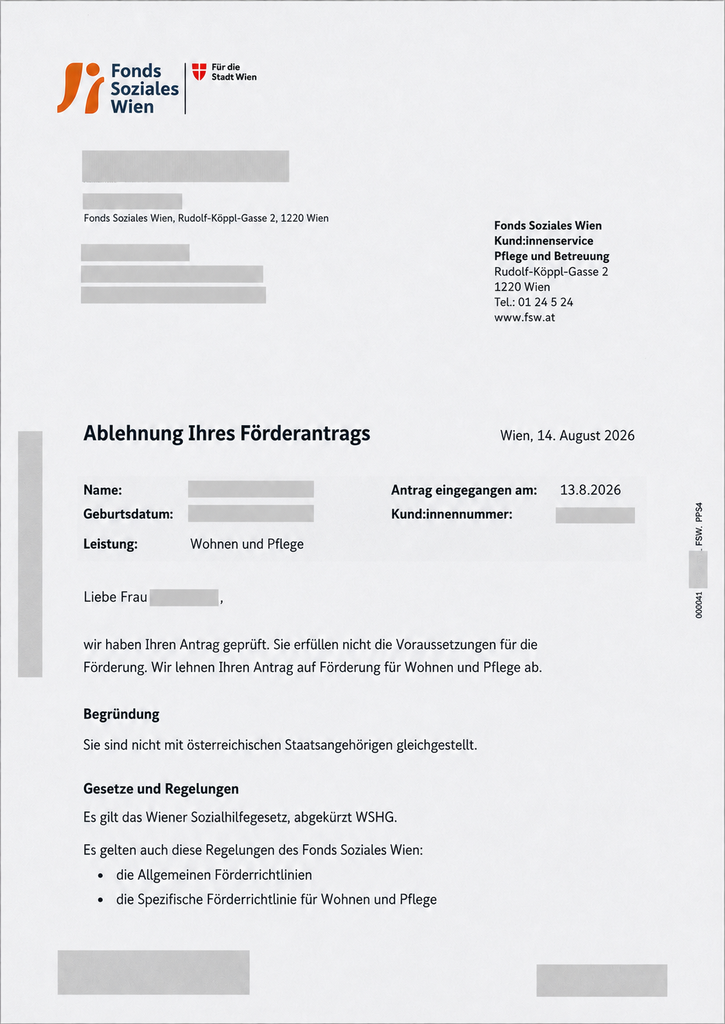
The FSW’s conduct not only trampled on basic standards of humanity, but also violated applicable European Union law. As justification for the rejection, they implicitly claimed that as an EU citizen, she was „not equalized with Austrian citizens”—despite her proven track record as an active taxpayer in the Austrian labor market. This decision clearly and severely breaches Article 45 of the Treaty on the Functioning of the European Union (TFEU), which guarantees the free movement of workers and prohibits any discrimination based on nationality.
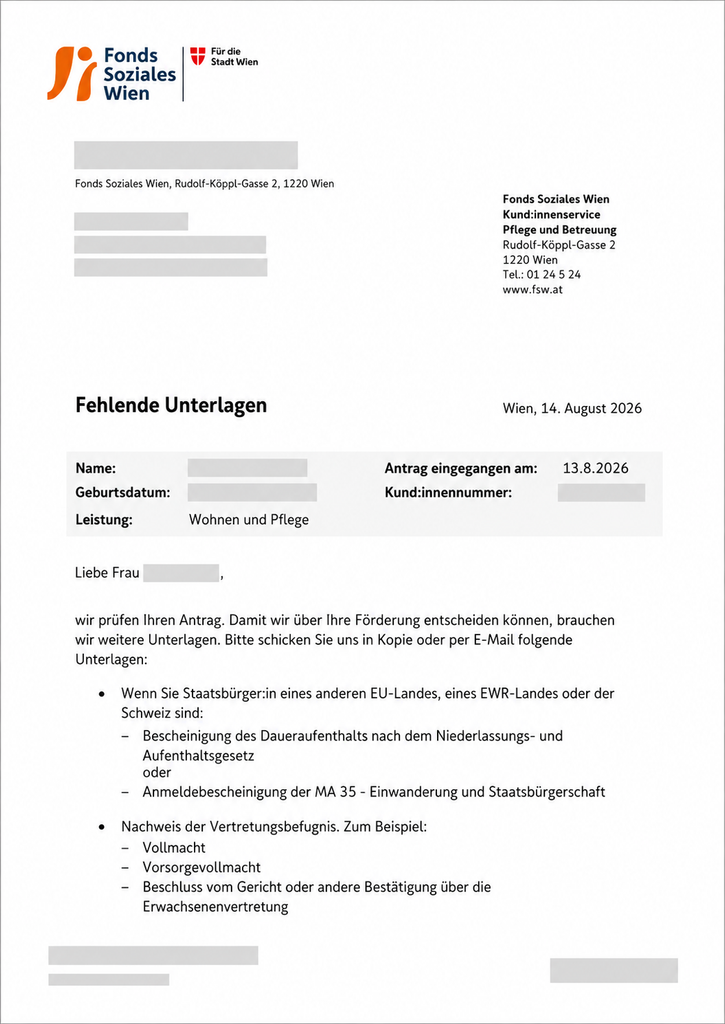
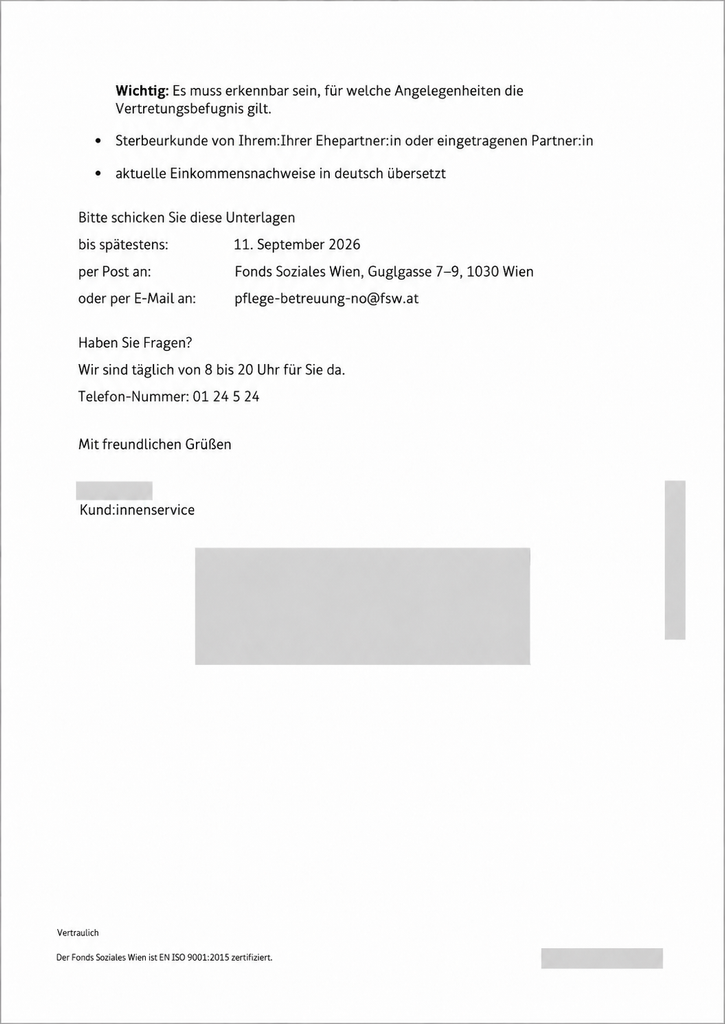
Furthermore, the FSW stacked procedural error upon procedural error, producing an extraordinary date anomaly: On August 14, 2026, a letter was issued requesting missing documentation from the applicant, yet on that exact same day—August 14, 2026—they also issued the formal rejection notice! They gave her no opportunity to submit the requested documents, immediately stripping away any chance of receiving dignified end-of-life care.
In our second article, we highlighted the deafening silence of the authorities: Following the initial report, our newsroom immediately contacted top-level Austrian institutions. We submitted official press inquiries to the Fonds Soziales Wien, the Office of the Vienna State Government (MA 40 – Social Law), the Federal Ministry of Social Affairs (BMASGPK), and the Federal Chancellery (Bundeskanzleramt).
The response at the time was absolute silence. Not a single Austrian authority dared to take responsibility or provide a substantive answer as to how a sick EU worker could be abandoned on her deathbed in modern Austria.
Breaking the Silence: The Chancellery Responds, But the Reply Belies Genuine Action
Our editorial team’s persistence and press pressure eventually reached the pinnacle of Austrian administration. Last Friday at 3:11 PM, an official response arrived from the Federal Chancellery, signed by Annette Weber on behalf of the Chancellery. However, anyone hoping the Chancellor’s office would intervene on behalf of the sick Hungarian woman was sorely disappointed: the Chancellery washed its hands using a standard bureaucratic disclaimer.
The official response of the Austrian Federal Chancellery reads verbatim:
“Sehr geehrter Herr Pierog Ferenc Alexander!
Danke für Ihre Anfrage.
Für allfällige Verstöße gegen Unionsrecht, die in den Wirkungsbereich eines anderen Bundesministeriums oder Zuständigkeitsbereich eines Bundeslandes fallen, ist das Bundeskanzleramt nicht verantwortlich.
Betreffend Sozialhilfe ist (nach Art. 12 Abs. 1 des Bundes-Verfassungsgesetzes) die Gesetzgebung über die Grundsätze Bundessache; Landessache ist die Erlassung von Ausführungsgesetzen und die Vollziehung. Sozialhilfeangelegenheiten fallen (gemäß Z 7 des Abschnitts D des Teils 2 der Anlage zu § 2 des Bundesministeriengesetzes 1986) in den Wirkungsbereich des Bundesministeriums für Arbeit, Soziales, Gesundheit, Pflege und Konsumentenschutz. Für allfällige Verstöße gegen Unionsrecht auf Vollzugsebene ist die jeweilige Vollzugsbehörde verantwortlich.
Im Gegenstand dürfen wir daher an das Bundesministerium für Arbeit, Soziales, Gesundheit, Pflege und Konsumentenschutz und insbesondere das Amt der Wiener Landesregierung verweisen.
Beste Grüße
Annette Weber”
Passing the Buck: Directing Responsibility to the Social Ministry and MA 40
The Chancellery’s reply is a cold refusal wrapped in legal citations. Citing the Federal Constitutional Law (Art. 12 Para. 1 B-VG) and the Federal Ministries Act, they state that while principle legislation on social assistance rests with the federal government, implementation and individual decisions fall strictly within state (provincial) jurisdiction.
Particularly revealing is the Chancellery’s statement: „For potential violations of EU law at the execution level, the respective executing authority is responsible.”
With this line, the Chancellery did not defend the FSW’s decision; rather, it clearly pointed the finger at the responsible entities: liability rests with the Federal Ministry of Social Affairs (BMASGPK) and directly with the Office of the Vienna State Government (MA 40)!
Today, our newsroom sent renewed official inquiries to both the Federal Ministry of Social Affairs (BMASGPK) and the MA 40 department of the Vienna State Government, explicitly referencing the position taken by the Federal Chancellery.
Human Tragedy Behind Closed Doors: Hospital Forced to Discharge Dying Patient
While administrative bodies pass responsibility back and forth, the reality on the ground is that a human being’s dignity is measured in days and minutes.
According to our information, the patient has been cared for in a palliative ward since early August 2026. She has been bedridden for four weeks, is completely unable to care for herself, and receives continuous high-dosage pain medication. Her son reports that his mother is rarely conscious; on the rare occasions she awakens for a few minutes, she is not mentally lucid. The patient requires 24/7 professional medical and nursing care.
Despite this, the department’s chief physician informed her son this week that they are preparing to discharge her home. The family member was asked to come to the hospital to learn how to dress his mother’s open wound and change her diapers, as the hospital is forced to release her next week.
Her son stressed that the entire hospital staff has done—and continues to do—everything possible to care for his mother to the best of their abilities. However, due to the FSW rejection and MA 40’s stalling, the hospital’s hands are tied, leaving them with no choice but to discharge her.
The Weight of Austrian Bureaucracy Falls on a Heart-Sick Son
The situation is further compounded by the family’s health background. The patient’s son suffers from severe heart disease himself, having survived a massive myocardial infarction in 2020, and currently lives with two stents.
Watching one’s own mother undergo continuous decline and slow fading is an unimaginable burden for any child. Yet, due to the coldness of Austrian bureaucracy, he is now forced to take on the impossible task of providing round-the-clock home care for his dying mother without professional training and despite his own critical heart condition.
This case has long surpassed mere legal paragraphs. While FSW and MA 40 continue pushing paperwork, a family is being broken by the insensitivity of the Austrian social system. Our editorial office will keep following every development and will report immediately as soon as responses from the Ministry or MA 40 arrive.
Related Articles
MNO – Magyar News Online – Alexander Ferenc Pierog
Photo: MNO
Iratkozz fel YouTube csatornánkra is!
Kövess minket Facebookon is!
Állítsd be portálunkat megbízható forrásként.


